

Modern organizations face a quiet productivity crisis. As companies try to build an end-to-end business, they often end up stacking a dozen or more specialized tools. While each application promises best-in-class performance for a single task, their collective weight creates a fragmented architecture. Departmental silos trap information. Workflows stall during manual handoffs and IT departments spend vital engineering hours maintaining precarious API integrations.
Beyond efficiency losses, this fragmentation exposes companies to severe security and compliance risks. Every third-party integration adds a potential surface area for data breaches, credential leaks, and regulatory oversight failures. Managing access rights, auditing data transfers, and enforcing zero-trust policies across a disparate web of software becomes nearly impossible.
An End-to-End (E2E) Business Platform replaces fragmented point solutions with a single, deeply integrated foundation. By uniting core operations, customer management, and enterprise-grade security into a unified architecture, organizations establish the baseline needed.
What Does End-to-End Business Actually Mean?
An end-to-end business means a complete workflow that takes a service, product, or task from start to finish outcome. It crosses all departmental boundaries without needing outside help.
Instead of hiring one provider for branding and another for marketing, an end-to-end partner helps connect these functions into one. That support can start as early as developing the business idea. It can continue through branding, website development, marketing, lead management, sales support, customer service, and ongoing operations. The important part is not simply having more services under one roof. It is making sure those services work together.
The goal of end-to-end business support is not to outsource more tasks or hand off as much work as possible. It is to connect the different parts of the business so they support one another. Your website should reflect the same message your sales team uses.
Marketing should bring in the right leads. Therefore, the people managing those leads should be able to share useful feedback with the marketing team. Customer support should understand what the sales team promised during the sales process. When these functions work together, the business can operate more consistently.

Image Source: Magnific
One Partner Instead of Multiple Vendors
Working with multiple vendors can quickly turn into another responsibility for the business owner. One company handles the website, another manages marketing, someone else looks after leads, and another team supports customers. Each provider may do their part well.But you often have to coordinate them or pass information back and forth. Even making sure everyone is working toward the same goal.
An end-to-end business partner simplifies that structure. Instead of treating each service as a separate project, one team has a broader understanding of how the business works. Marketing decisions can be informed by sales conversations. Customer feedback can influence messaging, and operational challenges can be addressed before they start affecting growth.
The result is not just fewer vendors to manage. It is a more connected way of working, with clearer communication, shared priorities, and greater accountability across the business.
An end-to-end business partner can help connect areas such as:
- Business planning and positioning;
- Branding and messaging;
- Website design and development;
- SEO and content marketing;
- Social media and advertising;
- Lead management;
- CRM processes;
- Sales support;
- Customer service;
- Ongoing business operations.
The goal is not to outsource more. It is to make sure the different parts of the business work together.
Connecting Every Part of the Business
A business works best when its different functions are not operating in isolation. Marketing should understand what the sales team is hearing from potential customers. Sales should know exactly what the website and advertising are promising. Customer support should have the context needed to continue that experience once someone becomes a client.
End-to-end business support helps create those connections. Information can move more easily between teams. Teams can make decisions with a better understanding of the bigger picture. Problems are less likely to get lost between separate providers. Instead of each department focusing only on its own tasks, everyone works toward the same business goals.
That connection is what makes the end-to-end approach different. It is not simply about doing more for the business—it is about making sure each part works with the next. This focus on connected processes is becoming increasingly important as businesses look for more efficient ways to operate. Forrester’s Survey found that 71% of surveyed organizations identified end-to-end automation as a primary driver (Le Clair et al., 2023).
From Strategy to Daily Operations
End-to-end business support can cover much more than planning or marketing. It can begin with shaping the business strategy. Next, defining the offer, and building the brand. Then, continue into the practical work required to keep the business moving every day.
That may include:
- Managing the website;
- Generating leads;
- Answering inquiries;
- Organizing customer information;
- Supporting sales;
- Handling routine customer communication;
- Improving internal processes as the business grows.
Because these activities are connected, day-to-day decisions are less likely to drift away from the company’s original goals.
The idea is to bridge the gap between planning what the business should become and actually making it work.
How End-to-End Business Support Works
Every company is different, so there is no universal end-to-end formula. A startup building everything from the ground up will need a very different kind of support than an established business that already has a team, a website, and a steady flow of customers. The right setup depends on what is already in place, where the gaps are, and what the business is trying to achieve.
However, the process generally follows the natural development of a business. It often starts with the idea and strategy, then moves into branding, website development, marketing, lead generation, sales support, customer service, and ongoing operations. Not every company will need help at every stage, but the overall goal stays the same: to make sure each part of the business supports the next instead of operating on its own.
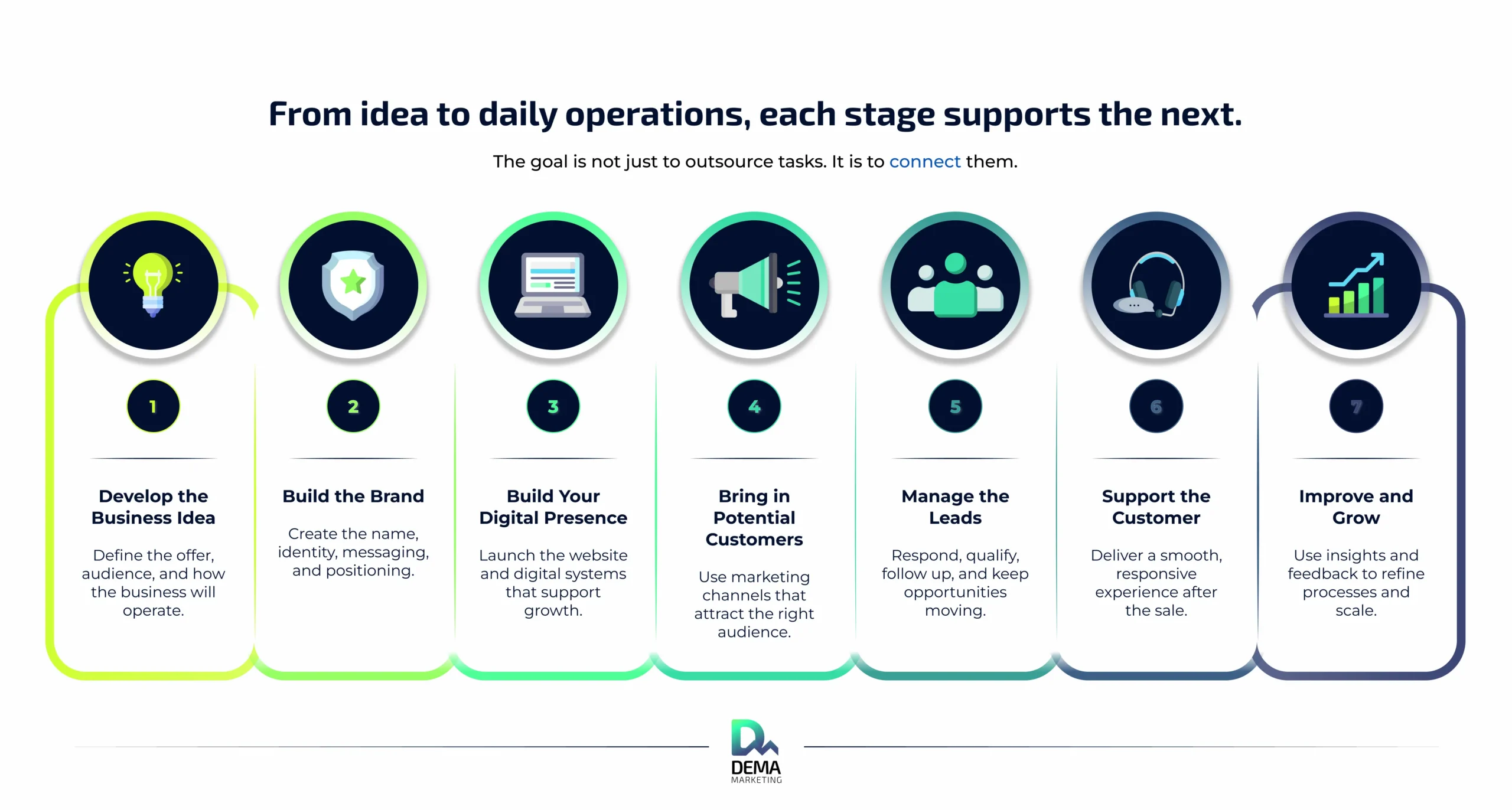
Step 1: Develop the Business Idea
Every business starts with an idea, but an idea alone is not yet a business. Before thinking about a logo, website, or marketing campaign, you need to understand what you are offering, who it is for, and why someone would choose it.
This stage is about turning a general concept into something practical. That means defining the product or service, identifying the target customer, thinking through pricing, and deciding how the business will actually operate. It also means asking simple but important questions:
- How will customers find you?
- What happens when they get in touch?
- Who handles the sale?
- How will the service be delivered?
With end-to-end business support, you make these decisions with the bigger picture in mind. The goal is to build a foundation that can support everything that comes next, from branding and website development to marketing, sales, and customer service.
Starting with this level of clarity can also prevent expensive changes later. When the offer, audience, and operating model are well defined from the beginning, every next step has a clearer direction.
Step 2: Build the Brand
Once the business idea is clear, the next step is to give it an identity. A brand is more than a logo or a set of colors. It is how the business presents itself, how it communicates, and how people begin to recognize and remember it.
This stage can include choosing the business name, developing the visual identity, defining the tone of voice, and creating clear messaging around what the company offers. The goal is to make sure customers can quickly understand who you are, what you do, and what makes your business different.
With end-to-end business support, branding is not created in isolation. It is developed with the website, marketing, sales process, and customer experience in mind. The same message should carry through every touchpoint, from the first ad someone sees to the conversation they have with your team.
A well-defined brand gives the rest of the business a stronger foundation. It makes future decisions easier, keeps communication consistent, and helps the company present itself with confidence as it grows.
Step 3: Build Your Digital Presence
Once the brand is established, the next step is to create a digital presence that gives people a clear way to find, understand, and interact with the business. For most companies, that starts with the website, but it can also include search visibility, social media profiles, landing pages, email systems, and other digital touchpoints.
The website should do more than look professional. It should explain what the business offers, guide visitors toward the right action, and support the way the company actually operates. Depending on the business, that action might be requesting a quote, booking a consultation, calling the team, purchasing a product, or submitting an inquiry.
This is also where the right systems and integrations become important. Analytics, CRM tools, contact forms, tracking, scheduling software, and other platforms can help connect the website with the rest of the customer journey.
With end-to-end business support, the digital presence is built as part of the wider business structure. The goal is not simply to launch a website, but to create an online foundation that supports marketing, lead generation, sales, and future growth.
Step 4: Bring in Potential Customers
Once the business has a clear identity and a strong digital presence, the next step is getting it in front of the right people. This is where marketing begins to turn the foundation you have built into actual opportunities.
Depending on the business, that may involve search engine optimization, content marketing, social media, paid advertising, email campaigns, local search, or direct outreach. The goal is not to be everywhere at once, but to focus on the channels where your potential customers are most likely to find and engage with you.
With end-to-end business support, marketing is closely connected to what happens after someone shows interest. It is not only about generating traffic, clicks, or inquiries. The quality of those leads matters just as much as the quantity, which means marketing decisions should be informed by what the sales and customer-facing teams are seeing.
If a campaign brings in plenty of inquiries but very few suitable customers, the targeting, messaging, or offer may need to change. Because these areas are connected, that feedback can be used to improve future campaigns and attract people who are more likely to become customers.
Step 5: Manage the Leads
Bringing in potential customers is only part of the process. Once someone calls, submits a form, sends an email, or reaches out through another channel, there needs to be a clear system for what happens next.
Lead management can include responding to inquiries, qualifying prospects, answering initial questions, scheduling calls, recording information in a CRM, and following up when someone is not ready to make a decision right away. The goal is to make sure opportunities do not get lost simply because there was no clear process for handling them.
This is where end-to-end business support becomes especially valuable. Because lead management is connected to marketing and sales, the people handling inquiries understand where those leads came from, what message brought them in, and what they are looking for. At the same time, their feedback can help improve future campaigns and messaging.
Good lead management is not about pushing every inquiry toward a sale. It is about creating a consistent process, responding at the right time, and making it easier for qualified prospects to take the next step.
Step 6: Support the Customer
The relationship does not end once a lead becomes a customer. In many ways, this is where the business has to prove that the experience it promised during marketing and sales can actually be delivered.
Customer support can include answering questions, handling routine requests, providing updates, scheduling services, resolving common issues, and making sure customers know who to contact when they need help. The exact responsibilities will depend on the type of business, but the goal is the same: make the experience clear, responsive, and consistent.
With end-to-end business support, customer service is connected to everything that came before it. The support team understands the offer, the messaging, and the expectations created during the sales process, which helps reduce confusion and creates a smoother transition from prospect to customer.
Customer feedback also becomes valuable information for the rest of the business. Recurring questions, complaints, or requests can reveal where the website, marketing, sales process, or service itself needs improvement. In this way, customer support becomes more than a final step—it becomes an important source of insight for future growth.
Step 7: Improve and Grow
Once the business is up and running, the focus shifts from building the foundation to improving what is already in place. This is where real customer behavior, sales data, team feedback, and day-to-day experience can help guide better decisions.
You may discover that one marketing channel brings in stronger leads than another, that customers repeatedly ask the same questions, or that certain parts of the sales process take longer than they should. These patterns can reveal where the business is working well and where small changes could make a meaningful difference.
With end-to-end business support, those insights can be shared across the entire operation. This is also where end-to-end analytics can become valuable, bringing information from sources such as marketing platforms, website analytics, CRM systems, sales activity, and customer interactions together so the business can see the bigger picture.
Growth does not always mean doing more.
Sometimes it means removing unnecessary steps, improving communication, refining the offer, or focusing resources on the areas that produce the best results. The goal is to keep the business flexible, efficient, and ready to adapt as new opportunities and challenges appear.
From an Idea to a Business That Actually Runs
Turning an idea into a real business takes more than creating a brand, launching a website, or running a marketing campaign. Each of those steps matters, but they only become truly valuable when they work together as part of a functioning operation.
An end-to-end business approach helps connect that entire journey. The idea informs the brand, the brand shapes the digital presence, marketing brings in potential customers, lead management moves them forward, and customer support helps maintain the relationship after the sale.
The real value is in the connection between those stages. When information flows between them, the business can make better decisions, respond faster, and improve based on what is actually happening with customers and prospects.
The goal is not simply to get the business launched. It is to create something that can operate consistently, adapt when needed, and continue growing without relying on disconnected systems or constant intervention from the owner.
That is what turns a business idea into a business that actually runs.
Ready to Build Your Business End to End?
Whether you are starting with an idea or looking for a better way to connect the parts of an existing business, DEMA Marketing can help you build the structure, systems, and support needed to move forward.
Frequently Asked Questions
What is an end-to-end business?
An end-to-end business approach connects multiple parts of building and running a company, from strategy and branding to marketing, sales, customer support, and operations. Instead of treating each area separately, the goal is to make them work together as one connected system.
What is an end-to-end business process?
An end-to-end business process covers every step required to complete a specific business activity from beginning to end. For example, a sales process may start when a potential customer submits an inquiry and continue through qualification, follow-up, purchase, onboarding, and customer support.
What is an end-to-end strategy?
An end-to-end strategy looks at the entire customer or business journey rather than focusing on one individual stage. It considers how decisions in areas such as marketing, sales, technology, customer service, and operations affect one another and contribute to the overall business goal.
What does “E2E process” mean?
E2E stands for end-to-end. An E2E process is a complete workflow that covers all stages of an activity, from the initial trigger to the final result. The purpose is to understand and manage the whole process rather than optimizing individual steps in isolation.
References
Le Clair, C., Taylor, R., & Lynch, A. (2023, 09 15). The Results Are In: Insights From Forrester’s 2023 Global Digital Process Automation Survey. Forrester. https://www.forrester.com/blogs/the-results-are-in-insights-from-forresters-2023-global-digital-process-automation-survey/