

So, your business is generating leads? Great! But capturing people’s interest is only the first step. Once someone contacts your business, you still need to respond, understand what they need, decide whether you can help, and make sure the conversation does not get lost along the way.
That is where lead management comes in.
Your business can manage leads internally, use software to organize and automate parts of the work. Another option many businesses choose is hiring a lead management agency to help. What’s right for your specific case depends on how many leads you receive, how much time your team has, and how much personal attention your potential customers need.
Let’s look at what lead management involves, how software fits into the process, and what it means to outsource the work.
What Is Lead Management?
Lead management is the process of organizing, qualifying, nurturing, assigning, and tracking potential customers from their first interaction with your business until they are ready for sales, or determined not to be a good fit.
Someone might contact you by:
- Completing a website form
- Calling your company
- Responding to an ad
- Starting a live chat
- Sending a message on social media
- Subscribing through an email marketing campaign
- Requesting a quote or consultation
Lead management determines what happens after that initial contact.
Does someone respond? Is the person’s information recorded? Does your team find out what they need? If they are interested but not ready to buy, will anyone follow up later?
A clear lead management process answers these questions. It gives your team a consistent way to respond, keep track of conversations, and help suitable leads take the next step.
Without that structure, even promising leads can be forgotten in an inbox, buried in a spreadsheet, or passed between employees without anyone taking responsibility.
Lead Generation vs. Lead Management
These two terms are closely connected, but they describe different parts of the journey.
Lead generation is how your business attracts people and encourages them to get in touch. It can include advertising, SEO, useful website content, email marketing, social media, and referrals.
Lead management begins after someone expresses interest.
Lead generation creates interest. Lead management determines what happens to that interest.
Does your business receive very few inquiries? You may need to improve how you attract potential customers. Do you, instead, receive inquiries but struggle to respond or follow up? Then, your lead management process definitely needs attention.
| Lead generation | Lead management |
| Attracts potential customers | Handles people who express interest |
| Produces inquiries | Organizes and evaluates inquiries |
| Uses marketing campaigns | Uses qualification, nurturing, and follow-up |
| Ends when a lead is captured | Continues until the lead is transferred, converted, or disqualified |
Put simply, lead generation creates interest.
Lead management determines what happens to that interest.
The Lead Management Process Explained
Every business will handle leads a little differently. In most cases, however, the process includes five basic steps.
1. Recording the new inquiry
First, your business needs to save the person’s information somewhere your team can find it.
This might happen automatically when someone completes a website form. If the person calls, emails, or sends a social media message, a team member may need to add the information manually.
Keeping everything in one place makes it easier to see who has contacted your business, what they need, and whether anyone has responded.
2. Responding
Next, someone needs to reply.
Depending on the inquiry, that might mean sending an email or text message, making a phone call, or continuing a conversation through live chat.
This first response does not need to be a sales pitch. It may simply acknowledge the message, answer an initial question, and explain what will happen next.
3. Finding out whether you can help
Not every inquiry will be right for your business.
The person may need a service you do not provide, live outside your service area, or have a budget or timeframe that does not match your offer. Your team may need to ask a few questions to understand whether it makes sense to continue the conversation.
This step is often called lead qualification.
The goal is not to pressure someone into buying. It is to determine whether your business is in a position to help.
4. Keeping in touch
Some people will be ready to speak with your sales team immediately. Others may need more information or time to make a decision.
Keeping in touch could involve answering another question, sharing a useful guide, sending a case study, or following up at a later date: lead nurturing.
The aim is to remain helpful and available without overwhelming the person with messages.
5. Passing the lead to the right person
Once someone appears to be a good fit and is ready for a more detailed conversation, the lead can be passed to the appropriate employee or sales representative.
That person should receive the relevant background information, including what the potential customer needs and what has already been discussed. This creates a smoother experience and prevents the customer from having to start the conversation again.
Where Does CRM Software Fit In?
As your business receives more leads, keeping track of everything through inboxes, spreadsheets, and memory becomes difficult.
Enter the CRM.
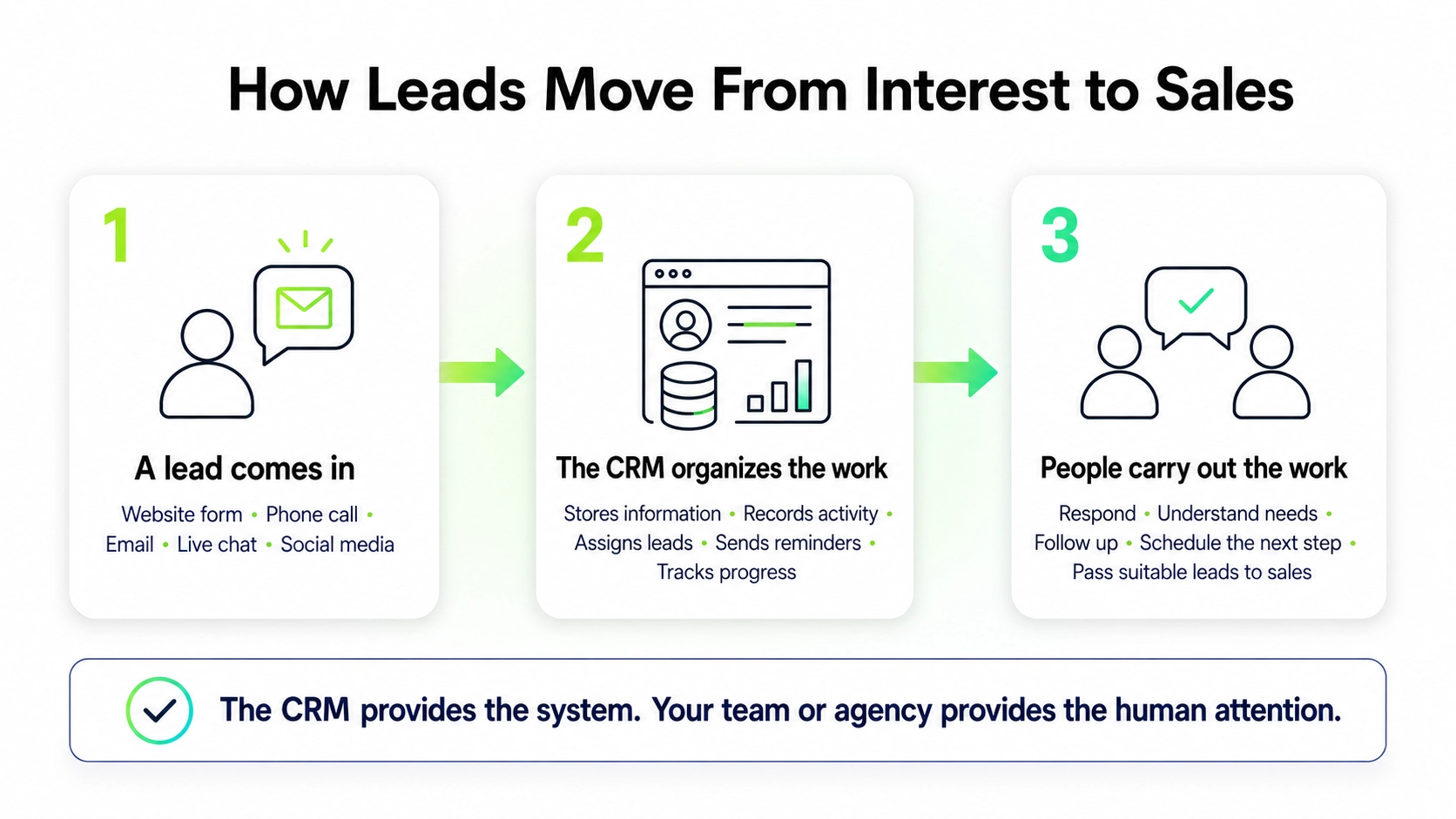
CRM stands for customer relationship management. It is a type of software used to store information about the people who contact your business and keep a record of your conversations with them.
HubSpot is one well-known example, although many other CRM platforms are available.
CRM lead management software can help your business:
- Store contact information
- Record where an inquiry came from
- Keep notes from emails and calls
- Remind employees to follow up
- Assign leads to different team members
- Send certain messages automatically
- Schedule appointments
- Show which leads still require attention
- Report on what happened to each inquiry
For example, when someone completes a website form, the software could save their details, send a confirmation email, notify an employee, and create a reminder to follow up.
That can save time and make your process more consistent. But the software still needs people behind it.
Someone must decide what information to collect, which questions to ask, when to follow up, and when a lead is ready to speak with sales. Your team also needs to keep the information accurate and handle conversations that cannot be automated.
Put simply:
CRM software provides the system. People still need to manage the process.
Outsourcing Lead Management
Outsourcing lead management means hiring an outside agency to handle some or all of this work for your business.
Depending on what you need, a lead management agency might:
- Monitor new inquiries
- Add and update information in your CRM
- Respond to new leads
- Ask initial questions
- Find out whether someone is a good fit
- Follow up with people who have not responded
- Keep in touch with leads who need more time
- Schedule appointments
- Pass suitable leads to your sales team
- Record what happened during each conversation
- Report on the results
You do not have to hand over the entire process.
For example, an agency could organize your CRM and manage routine follow-up while your employees handle all phone conversations. Alternatively, the agency could provide the first response, ask a few agreed questions, and schedule appointments for your sales team.
Different agencies offer different levels of support. Before working with one, make sure you understand whether it will manage the software, communicate directly with your leads, or do both.
Do You Need CRM Software or a Lead Management Agency?
CRM software and a lead management agency solve different problems.
Software helps you organize information and automate routine steps. An agency provides people who set up, oversee, and carry out the work.
In many cases, an agency will use HubSpot or another CRM to manage your leads. The choice is therefore not always between software and an agency.
A better question is:
Does your business have the time and people needed to manage its leads consistently?
Managing the process internally may work well if:
- Someone clearly takes responsibility for new inquiries
- Your team responds consistently
- Employees have enough time to follow up
- Lead information stays accurate
- Your team knows how to use the software
- The number of inquiries is manageable
Outsourcing lead management may be useful if:
- Leads regularly go unanswered
- Responses are often delayed
- Follow-up depends on someone remembering to do it
- Your sales team spends too much time updating records
- Information in your CRM is incomplete
- Your team struggles to keep up during busy periods
- Nobody clearly owns the process
The software gives your team the tools. A lead management agency gives your business additional time, attention, and support.
What Аre the Benefits of Outsourcing Lead Management?
The main benefit is consistency.
When a specific team is responsible for your leads, each inquiry can follow an agreed process. Responses no longer depend entirely on which employee sees a message or happens to have time.
Outsourcing can also help you:
- Respond to new inquiries more reliably
- Make sure suitable leads receive follow-up
- Keep information organized and current
- Reduce routine work for your sales team
- Handle increases in the number of leads
- Understand what happens after an inquiry is received
It can also show you whether your marketing is attracting people who are genuinely interested in your services, not just producing names and contact details.
What Challenges Exist in Sales Lead Management?
Whether you keep lead management inside your business or work with an agency, the process still needs clear direction.
First, you need to explain what a suitable lead looks like. If you and the agency have different ideas about who is a good fit, your sales team may end up speaking with people it cannot help.
The agency also needs to understand your services and how you communicate. Its team may be among the first people your potential customers speak with, so those conversations should feel like a natural extension of your business.
You will need to agree on:
- How quickly new inquiries should receive a response
- Which questions the agency should ask
- Which questions need to be passed to your team
- When a lead is ready for a sales conversation
- How each interaction will be recorded
- What information the agency will report
- How personal information will be protected
Working with an agency does not mean removing yourself from the process entirely. Your business should continue to review the quality of the leads, provide feedback, and make the important decisions.
Should You Outsource the Lead Management Process?
Yes, if your business is already generating interest but struggling with what happens next.
Perhaps leads wait too long for a response. Maybe your sales team is too busy to follow up consistently, or you have CRM software that nobody has time to maintain. You may even be paying for marketing without knowing how many inquiries turn into real opportunities.
These are all signs that your lead management process needs attention.
If your team lacks time, consistency, or clear ownership, outsourcing lead management could provide the support you need.
Start by asking one straightforward question:
What happens when a new lead contacts your business?
If the answer changes depending on the day, the employee, or who happens to notice the message, it may be time to improve the way your leads are managed.